
Key takeaways
- Coaching means enabling, not doing it for you: your team implements, we provide structure, reviews, and decisions.
- 90 days, three phases: lead generation, webinar and demand, conversion and scaling.
- There's a gate before day one: ad account, tracking, CRM, and automation all need to be in place, or nothing starts.
- Requirements: customer value above €3,000, at least €1,500 in media budget a month, one person who owns the implementation.
- Not a fit for everyone: if nobody on the team has the time or the interest to learn, an agency is the more honest choice.
Most B2B teams start by looking for an agency. They end up in a retainer, staring at reports nobody actually acts on, and a year later find themselves right back where they started: with no capability of their own. LinkedIn Ads coaching flips that. You build the funnel yourself, with someone next to you who's built it many times before.
This page describes exactly how that works in practice. Not marketing copy, but the real roadmap from our client projects: what the phases are, what happens in which week, who does what, and where coaching falls apart when the requirements aren't there. If you want to get your bearings on the channel first, the whole system is laid out in the complete guide to LinkedIn Ads for B2B.
What Is LinkedIn Ads Coaching?
LinkedIn Ads coaching is a time-boxed program where a practitioner works alongside your inhouse marketing team to build the complete funnel, from the first awareness ad to a booked demo call. The work stays with you. Coaching provides the sequence, the templates, review before every publish, and the decision-making at the points where getting it wrong gets expensive.
The difference from the alternatives, in one sentence each:
You build it, we guide you
Weekly calls, KPI review, feedback on creatives and copy before launch. After 90 days, the system and the know-how belong to you, the only ongoing cost is the ad budget itself. Who on the team owns which job is covered on the page about the in-house team.
You build it alone
A self-paced course gives you the material without live guidance. Cheaper and at your own pace, but without anyone reading your numbers alongside you and catching mistakes early.
Someone else builds it for you
Fast capacity, no learning curve of your own. But the costs keep running for as long as the campaigns run, and the capability stays outside your company.
One-off knowledge, no system
A one-day workshop builds a foundation and a shared vocabulary. It doesn't produce a working funnel, that takes several months of hands-on implementation.
The honest trade-off between outsourcing and doing it yourself, including the signals of a good agency, is covered in detail in the guide to LinkedIn Ads Agency or In-House.
Who LinkedIn Ads Coaching Is For
Coaching is a fit if you:
- work in B2B marketing, as a marketing manager, CMO, or inhouse team, and want to run LinkedIn Ads yourself
- sell an offer that needs explaining and carries a higher price tag, one where multiple people are part of the decision
- have already put budget into ads but aren't getting predictable booked calls out of it
- want to become independent of agencies, because the system should stay in-house
- are willing to put in several hours a week on the implementation yourself
Coaching isn't a fit if you:
- operate purely in B2C, or sell a low-priced product with no real sales process behind it
- want someone to take the whole thing off your hands, in that case an agency is the more honest path
- don't have anyone on the team who can reliably own the implementation
- aren't willing to invest three months in building a system
The most common reason coaching stalls isn't a lack of knowledge, it's a lack of time on the client's side. Before you start, pin down, firmly, who owns the implementation and how many hours a week are actually blocked on their calendar for it. One person with a clear mandate beats three people with good intentions.
That is exactly what we build with B2B teams: not an agency mandate, but your own system. The overview shows how we work.
The Process: 90 Days in Three Phases
Our coaching follows a fixed roadmap. It's built so that each phase builds on the one before it, with a gate at defined points: if the milestone isn't hit, the next stage doesn't go live. That sounds strict, but it saves exactly the money that would otherwise get wasted on half-finished campaigns.
Phase 0: Setup, Before the 90 Days Start
Before day one, we check requirements in a setup call and get the technical side in place. Only once everything's ready does the clock start:
- Product and market: customer value above €3,000, a clear ICP, at least one case study, a documented sales process with clear ownership of leads and demo calls
- Infrastructure: CRM, email tool, automation, a website that can actually convert, at least €1,500 in media budget a month, a named point of contact in marketing
- Technical setup: ad account linked to the company page, Insight Tag installed and verified, conversion goals set up and tested
- Connections: Lead Gen Form connected to the CRM, email sequence triggers automatically, sales gets notified on every new lead
- Campaign sheet: marketing and sales fill it out together, because only sales knows the objections, buying motives, and deal breakers. This becomes the blueprint for everything that follows over the 90 days: audiences, hooks, ad copy, lead magnet, email sequence.
Which of these points are hard requirements, and how to tell that LinkedIn Ads are still too early for you, is covered in detail in LinkedIn Ads Requirements.
Month 1: Lead Generation
The first month builds the top of the funnel and everything that catches a lead once it comes in.
- Week 1: build at least two differently constructed audiences, exclude the ones that don't fit, and set up every retargeting audience. Launch the first awareness campaign, as Video Ads or Thought Leader Ads with at least three hooks. In parallel, the lead magnet concept gets locked in.
- Week 2: analyze the first campaign data, identify winners, pause weak ads. The email sequence gets written, at least six emails leading up to the first pitch. The lead magnet, Lead Gen Form, and automation get finished and tested.
- Gate before Week 3: email sequence active, lead magnet finished, automation tested. The lead gen campaign doesn't go live before that.
- Week 3: publish the lead gen campaign, test at least two lead magnet titles against each other, and manually trace the first lead through the entire process: coming in, email, LinkedIn message, call.
- Weeks 4 and 5: check CPL against benchmark, assess lead quality against the ICP, test new creatives and titles, and sharpen the follow-up process based on the first real conversations.
Milestone, month 1: awareness and lead gen campaigns are running, the first leads are in, the email sequence is working automatically, and every lead gets contacted within 24 hours.
Month 2: Webinar and Demand
Lead generation and nurturing keep running, and in parallel the conversion engine gets built. The webinar is where interest turns into buying interest, because it's the first time you pitch openly.
- Weeks 6 and 7: lock in the concept, title, and core message, build the deck, develop the pitch, and work in case studies. Alongside that, the email series for registration, reminders, and follow-up, split by attendees and no-shows. Set up and test the tech, fix the date.
- Weeks 8 and 9: promote the webinar, both paid and organic. Retargeting to everyone who's already had contact, plus Message Ads to the relevant audiences. If the warm audience is too small, add the cold one. Track registration numbers continuously.
Milestone, month 2: the entire webinar workflow is in place, the date is fixed, promotion is running, and the first registrations are in the CRM.
Month 3: Conversion and Scaling
This is where the funnel closes and turns into a repeatable process.
- Week 10: run the webinar. We're on the call with you, check tech, tracking, and the CTA link beforehand, cluster questions and objections during the webinar, and afterward go through the attendee list, follow-up, and next sales steps together. Hot attendees get a personal follow-up within 24 hours.
- Weeks 11 and 12: run demo ads to warm audiences, at least two variants, each with a clearly named offer like an analysis, a check, or an audit. Follow up with no-shows separately, with the recording and a new CTA. Document winners across audiences, hooks, and pain points, and establish the webinar as a recurring event, roughly every four weeks.
Milestone, month 3: one completed webinar with a fixed process behind it, demo ads running, conversion data analyzed, and a repeatable path from leads to booked calls to pipeline. How to feed those results back to LinkedIn afterward is covered under Tracking.
After the 90 Days
At the end comes a joint review: what won, across audiences, hooks, and pain points, and what the next levers are. From here, the funnel keeps running in-house. If you want, you can bring in guidance again for scaling on a case-by-case basis, but it's no longer necessary.
The Funnel You Build in Coaching
All three months pay into the same model. Seven stages that take a cold contact step by step to a booked demo call, instead of sending them straight to a sales conversation after a single click.
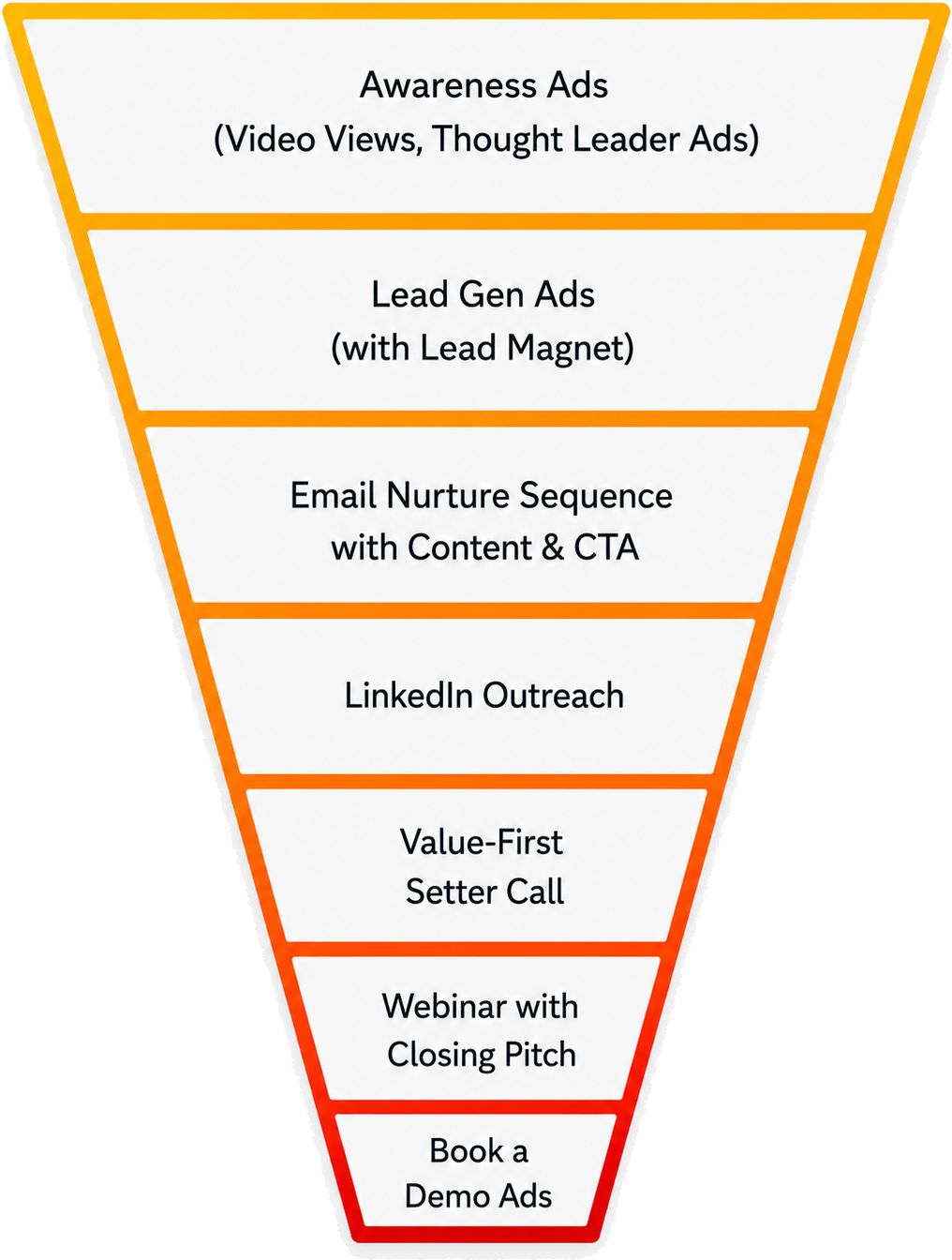
Why exactly this order works in B2B, and what individual ads can never achieve on their own, is covered in detail in the guide to the B2B Sales Funnel on LinkedIn.
What's Included in Coaching
Our coaching consists of three parts that belong together:
- The video curriculum as the knowledge base: six modules and 24 video lessons, from setting up the ad account through to scaling. Every week of the roadmap has fixed lessons you watch beforehand, so the live calls never get eaten up by the basics.
- The live guidance: joint KPI review, deciding which creatives to scale, feedback on copy and ads before they go live, briefing for webinar and demo ads, and presence at the webinar itself.
- The working materials: a targeting playbook, a copywriting playbook, a KPI and benchmark sheet, an optimization sheet, a campaign checker with a change log, and a library of more than 100 B2B ads to use as templates.
Coaching, Course, or Agency: What Fits When?
| Criterion | Coaching | Course | Agency |
|---|---|---|---|
| Who implements | Your team, guided | Your team, alone | The agency |
| Your own time | Several hours a week | Several hours a week | Low, but coordination needed |
| Cost structure | One-time, time-boxed | One-time, cheapest entry point | Ongoing, for as long as it runs |
| Who owns the capability afterward | You | You | The agency |
| Catching mistakes | Early, in the weekly review | Only once you spot them yourself | Depends on the reporting |
| Fits when | You want to own the skill and have the time | You work in a disciplined, self-directed way | Nobody on the team has the time or the interest |
How to Spot a Good LinkedIn Ads Coaching Program
The market for ads coaching is crowded, and quality varies wildly. These points separate genuine guidance from an expensive video course with a call bolted on:
- Real numbers, not theory: the coach runs their own campaigns and can tell you what a CPL should cost in your situation. Anyone who only explains frameworks has never actually owned a budget.
- The whole funnel, not just Campaign Manager: ads are the smaller part. The lead magnet, email sequence, outreach, setter call, and webinar are what actually decide whether leads turn into booked calls.
- A fixed roadmap with gates: without defined milestones, coaching turns into a loose Q&A session. Ask to see upfront what's supposed to be finished in which week.
- Review before publishing: creatives, copy, and campaign structure get reviewed before budget starts flowing, not just discussed afterward.
- An honest no: a good coach tells you upfront if your customer value, budget, or sales process isn't ready yet, instead of booking you anyway.
- Templates that belong to you: playbooks, sheets, and processes stay with you after coaching ends, otherwise you're right back in a dependency.
What LinkedIn Ads Coaching Costs
Three cost blocks belong together, and only the first one is negotiable:
- The coaching fee: one-time and time-boxed, unlike an agency retainer, which keeps running for as long as the campaigns do. We set the scope in the intro call based on your starting point.
- The ad budget: goes straight to LinkedIn, regardless of who's running the campaigns. Under €1,500 a month, you're not gathering enough data to optimize meaningfully. What's realistic is covered at LinkedIn Ads Budgets.
- Your time: the line item that gets underestimated most often. If you don't budget for the implementation, you end up paying for a system that never gets finished.
So the comparison with an agency isn't a pure price comparison. A retainer is the cheaper math for as long as you never actually want to run LinkedIn Ads yourself. Once the channel becomes a permanent part of your pipeline, the math flips, because coaching gets paid once and after that only the media budget keeps running.
If you want to know whether there's even enough substance for a funnel yet, start with the Requirements. And if you're still torn between outsourcing and doing it yourself, the comparison of Agency or In-House will help you decide.