
Key takeaways
- A funnel is a system of three stages, not a single campaign.
- Only about 3 to 5% of your audience is ready to buy right now, the rest needs to mature.
- The three stages: lead generation, trust & demand, conversion.
- Lead generation harvests demand, demand generation creates it. You need both.
- Pays off above a customer value of around €3,000, starting budget from €1,500/month.
The most common expectation for LinkedIn Ads: run a good ad, and the leads show up. The most common disappointment follows shortly after. Because predictable B2B leads aren't the result of a single ad, they're the result of a system. The reason comes down to a single number: only about three to five percent of your audience is ready to buy right now. The rest aren't there yet. Valuable contacts, but ones that still need to mature. Push a demo on them too soon and you waste budget. Develop them through a funnel and you win them over. This is exactly the funnel we build with our clients, and it's exactly what this guide walks through.
The foundation, before you run traffic
Before the first ad goes live, the technical groundwork needs to be in place: the LinkedIn Insight Tag (LinkedIn's tracking snippet for your website), conversion tracking, and the CRM connection. The sales side matters just as much: clear definitions for marketing-qualified lead (MQL), sales-qualified lead (SQL), and a concrete opportunity, a documented follow-up process, and the capacity to respond to leads quickly. And your website needs to be conversion-optimized. If any of that's missing, build it first, not more budget.
Equally honest up front: LinkedIn Ads don't pay off for everyone. Whether your offer, budget, and audience are even the right fit, and which building blocks need to be in place first, is covered in the guide to LinkedIn Ads Requirements.
The LinkedIn Ads Master System: three stages
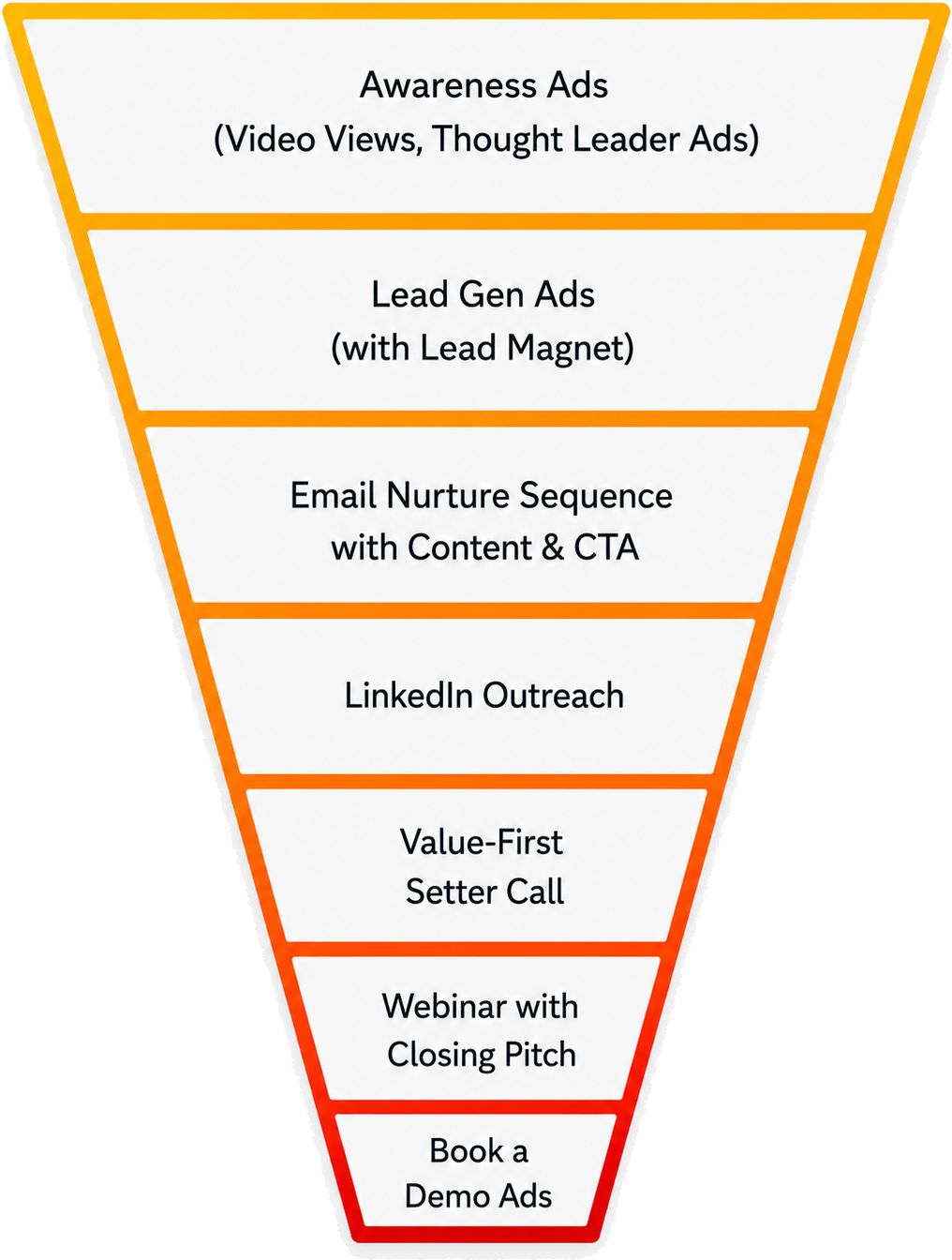
Our funnel consists of three stages that build on each other. Each has its own job, and each pre-qualifies before handing off to the next. That way, sales never ends up talking to a cold contact, they talk to a warmed-up lead who already knows you.
Lead generation
Build awareness and collect qualified leads. At the top: Video Views, Thought Leader Ads, and Spotlight Ads for reach and to fill the retargeting pools. In parallel, a strong lead magnet to the cold audience, via Single Image ads with a Lead Gen Form or Document Ads.
Trust & demand
Contacts turn into prospects. An email sequence, personal outreach on LinkedIn, and the first setter call (a short qualification call from sales) build trust. A webinar goes deeper on the topic and becomes the real demand engine.
Conversion
The final step to a booked call. Retargeting only brings warm, qualified leads into the calendar: demo, case study, and testimonial ads to the audience that already knows you. The demo isn't framed as "book a demo", it promises real value.
That is exactly what we build with B2B teams: not an agency mandate, but your own system. The coaching walks your team through it. The overview shows how we work.
Stage 1 in detail: from ad to qualified lead
The first stage determines the quality of everything that follows. Before you build a single ad, it's worth understanding a distinction that trips up most campaigns. There are two ways to get B2B leads, and they solve different jobs.
| Lead Generation | Demand Generation | |
|---|---|---|
| Goal | convert existing interest into contacts | create demand in the first place |
| Mechanics | Lead Gen Form, lead magnet, clear CTA | content, video, thought leadership without a CTA |
| Result | immediately measurable leads, often not yet ready to buy | a larger warm pool, better leads later |
| Limit | only reaches the few who are already searching | works more slowly and is harder to measure |
If you only run lead generation, you keep harvesting the same small percentage and wonder why the channel dries up. If you only run demand generation, you build reach but no measurable inquiries. You create demand at the top of the funnel and harvest it at the bottom with a clear offer. In practice, the lead stage runs in three steps:
- Buy attention cheaply. A Single Image Ad with a lead gen objective to a tightly defined audience. The goal isn't an immediate close, it's a cheap entry point into the funnel. Buy below market price and you can afford more touchpoints.
- A lead magnet you can't ignore. A snackable asset with real value, something people would actually pay for. Call it a checklist, playbook, or guide, not a whitepaper. The quality of the lead magnet determines the quality of the leads.
- Lead Gen Form or landing page. The native Lead Gen Form auto-fills with profile data and brings in more submissions at a lower barrier. The landing page gives more room for trust-building and qualification, and fits higher-value offers. When in doubt, run both against each other and decide based on lead quality, not volume.
Common advice says to create demand with content first and harvest leads only later. The paid-first approach flips that: you use ads to pull contacts into your own CRM early, then nurture them with content afterward. The difference is ownership. Reach on LinkedIn is rented ground the algorithm can restrict at any time, the contacts in your own CRM belong to you. Two things follow from that. Never measure a demand generation campaign on cost per lead, it doesn't have one, it pays off in reach, dwell time, and the warm pools it builds. And never rely on gated forms alone, or you'll cap your pipeline at the small percentage who are already searching.
Stage 2 in detail: building trust and demand
Someone who downloaded the lead magnet isn't ready to buy yet. This stage fills the warm pool that stage 3 later harvests bookings from. How the follow-up and the webinar actually play out, from the email cadence to personal outreach to the reminder series, is covered in the guide to B2B Appointments via LinkedIn Ads.
Stage 3 in detail: harvesting the booking
Demo, case study, and testimonial ads now run to the warm audience. Because these contacts already know you, they convert at a fraction of the cost of a cold audience. How to frame the call to action, which ad format actually delivers bookings, and how to separate mature leads from immature ones is covered in more depth in the guide to B2B Appointments via LinkedIn Ads.
Why this funnel works
Why exactly this order wins in B2B, and what a single ad can never do on its own:
- B2B purchases aren't spontaneous. A buying committee of six to ten people makes the decision, and months pass with dozens of touchpoints before it turns into a deal. A single ad can't do that. The funnel accompanies the contact across many touchpoints until trust exists among everyone involved.
- Every stage pre-qualifies. Instead of wasting budget on cold audiences, each stage filters. Retargeting only runs on people who've already shown interest. That way your money flows to where it actually works.
- Trust builds before the pitch. Nurturing, content, and the setter call build buying interest. By the time the demo call happens, it's not a cold contact on the line, it's someone who already knows you.
- A system, not isolated actions. The stages interlock and reinforce each other. That's exactly why the result is predictable and scalable instead of left to chance.
The B2B buying process is long, and it isn't getting shorter. A Dreamdata analysis shows the scale: the average customer journey runs around 211 days, or roughly seven months, and dozens of touchpoints across multiple channels happen before a decision is made. According to Gartner, six to ten people sit on the buying committee. And 81 percent of that journey happens before sales ever gets involved. These are benchmark figures, not a fixed market average, but the direction matches what we see in our own accounts. Accompany those months with plenty of touchpoints, and you're in the room by the end. Wait for the one perfect ad, and you're not.
How your budget shifts over time
A funnel is deliberately top-heavy at the start. In the beginning, the warm audiences don't exist yet, so most of the budget has to flow into the first stage just to fill the retargeting pools. Over the months, that ratio shifts. A proven rough allocation:
| Phase | Lead generation (cold) | Trust & demand (warm) | Conversion (hot) |
|---|---|---|---|
| Months 1 to 3 | 70% | 20% | 10% |
| Months 4 to 6 | 55% | 25% | 20% |
| From month 7 | 45% | 30% | 25% |
That also explains why the first quarter brings few leads at a high cost per lead, and why that isn't a mistake: you're watching the pools fill up. Why a good funnel shows so little visible result at the start, and why that's exactly not a reason to shut it down, is covered in more depth in the guide to the Shadow Funnel.
The conversion stage is the cheapest per lead, which makes it tempting to pour most of the budget there. That's exactly what tips the funnel over. The conversion stage can only harvest the demand the first two stages created. Overfund it, and you'll exhaust the warm pool within a week, frequency spikes, and cost per lead climbs back to cold-audience levels. Keep the bottom stage small. It lives on what flows down from above.
Every stage has its own metric
A blended cost per lead across all stages is nearly worthless, because lead generation always looks expensive and conversion always looks cheap. Measure each stage against its own job:
- Lead generation: reach within the target audience, growth of the retargeting pools, cost per video view, and cost per lead on the cold audience.
- Trust & demand: size of the warm pools, engagement rate from warm audiences, an increase in direct and branded search.
- Conversion: cost per lead in the warm segment, lead-to-booking rate, and ultimately the pipeline generated.
Why lead quality matters more than lead volume
A full lead inbox feels good, but it doesn't say much. Whether leads become customers comes down to the lead magnet and the funnel stage they came from. Both are covered in depth in the guide to Lead Quality.
A fresh lead is a marketing lead, not a sales lead. How to tell which lead is ready for sales is covered in B2B Appointments via LinkedIn Ads. The art of lead generation isn't harvesting, it's maturing.
From zero to a scaling funnel in three months
Here's how you put the system into practice. We use this exact roadmap in coaching too:
| Month | Focus | What you have by the end |
|---|---|---|
| Month 1 | Lead generation | Ad account and tracking are set up, the first video and thought leader campaigns are live, the lead magnet and Lead Gen Ads bring in the first qualified leads, the email sequence nurtures automatically. |
| Month 2 | Webinar & demand | Lead gen keeps running. The webinar concept, pitch, and email series are in place and get promoted via ads and retargeting. Nurturing becomes a system. |
| Month 3 | Conversion & scaling | Retargeting reliably brings warm leads into the calendar. You scale what's working and lower CPC and CPL week over week through the ongoing routine. |
How to scale cleanly in month three and keep lowering costs is covered in the guide to Optimizing LinkedIn Campaigns. Once the funnel holds and you want to grow beyond LinkedIn, How to Scale B2B Marketing picks it up from there.
Sales and marketing can't think in silos
One of the biggest levers isn't in the algorithm, it's in your own organization. Information needs to flow in both directions:
- Sales to marketing: target account lists flow directly into targeting (Company List Upload). Marketing then knows which companies to reach, not just which job titles. That cuts wasted spend.
- Marketing to sales: which companies got reached, which ones engaged? The Company Engagement Report in Campaign Manager delivers that list, even without a CRM, as a conversation starter for sales. Point the funnel specifically at a fixed set of target companies, and you're doing Account Based Marketing, where this exact handoff is the whole point.
- Together: alignment runs through lead quality. Sales feedback on which leads were good is the single most valuable signal for ongoing optimization.
One day of alignment up front saves three months of chaos afterward.
The most common reason funnels don't convert: too much at once. A strong funnel follows the Rule of One. One target persona, in one industry, with one product and one solution. Target ten personas with five offers at the same time, and you don't really hit anyone. Clarity is the prerequisite to getting started, perfectionism is its enemy.
The most common mistakes
- The demo ask to a cold audience. You only reach the three to five percent who are buying right now, and pay high click prices for barely any results.
- No follow-up behind the lead magnet. The leads come in, but nobody follows up. That devalues all the work that went into getting them.
- A weak lead magnet. Something you could just google won't convince anyone to hand over their contact details.
- Targeting that's too broad. Without a sharp audience, you pay for clicks from people who'll never buy. The guide to LinkedIn Ads Targeting covers how to do it better.
- Overfunding the bottom stage. Pour the budget into conversion, and you'll exhaust the warm pool faster than it refills.